Grand Opening & Black Friday Sale  =  50% Off 

photographing meteor showers
Down Arrow

Our Guide to Photographing Meteor Showers in the Night Sky

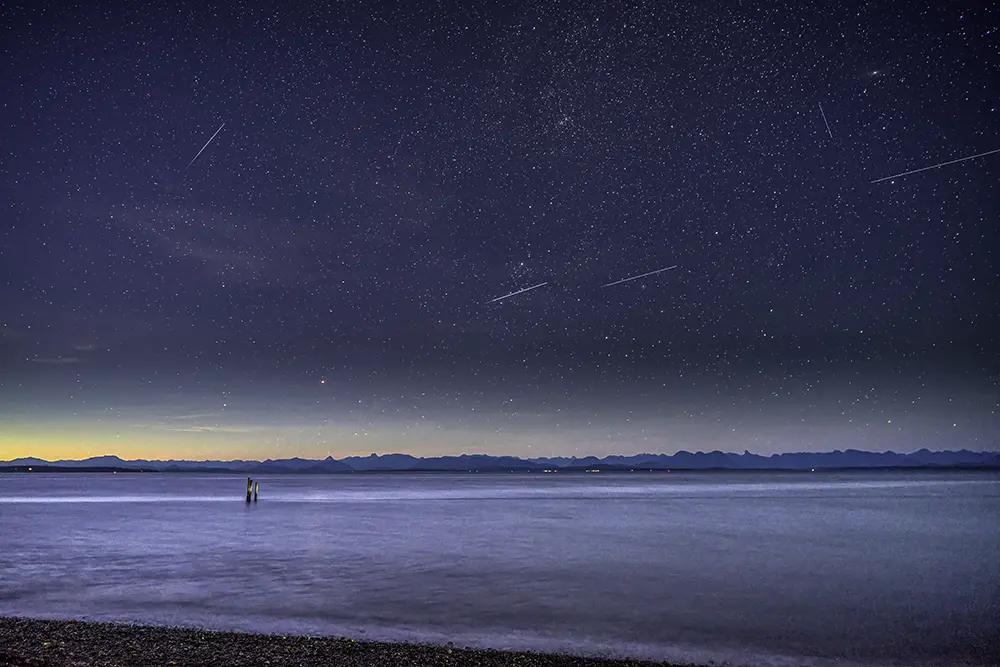
Photographing a meteor showers can be an unforgettable experience. Imagine capturing the dazzling streaks of meteors, each frame telling a unique story. In this guide, we’ll share our tips to help you set up your camera, choosing the right settings, and finding the perfect spot. Whether you’re using a full-frame or APS-C camera, you’ll be ready to photograph meteor showers in no time.

Let’s dive in and start shooting those spectacular night skies!

Key Takeaways

  • Meteor showers occur when comet debris passes through Earth.
  • Patience and the right gear are key.
  • Wide-angle lenses are best for the night sky.
  • Dark areas away from city lights are ideal for viewing.
  • Knowing how to set your camera is crucial for capturing meteors.
  • The best showers are Geminids and Perseid meteor shower

Table of Contents

Meteor shower timeline

If you get nothing else from this page, at least book mark it so you can come back and use the following table.

Major meteor streamsActivePeak Night ( +/- 2 days)Rate Per HourVelocity klm/s
QuadrantidsDec 26-Jan 16Jan 3-411040.2
LyridsApr 15-Apr 29Apr 21-221846.8
Eta AquariidsApr 15-May 27May 5-65065.5
Southern DeltaJul 18-Aug 21Jul 29-302540.3
PerseidsJul 14-Sep 01Aug 12-1311058.8
OrionidsSep 26-Nov 22Oct 21-222066.1
LeonidsNov 03-Dec 02Nov 17-181570.0
GeminidsNov 19-Dec 24Dec 13-1414033.8
UrsidsDec 13-Dec 24Dec 22-231033.0

The above-mentioned meteor showers are the most active and easiest to photograph. The best time to observe each shower varies slightly from year to year. Your biggest challenge is that the moonlight conditions vary significantly. 

I’ve always found after midnight to be the best for viewing meteor showers. Some aren’t even apparent until well past midnight. 

Black Friday deals on now! Save up to 77% – Plus an additional 10% when you use code bwild10

How to prepare for meteor photography

Getting ready for meteor photography requires careful planning and the right gear. Let me walk you through the essentials to capture stunning meteor showers.

Choosing the right lens for Meteors

A wide angle lens is key for any astrophotography. I suggest using a 10-25mm lens for crop sensors or a 16-35mm for full-frame cameras. A wide-angle lens lets you capture more of the night sky, increasing your chances of capturing a meteor racing through your frame. 

My favourite lens for photographing meteor showers is a 24mm 2.8. on a full frame

Camera settings are essential for shooting meteors.

For successful meteor photography, these settings are crucial:

  • Manual focus is set to infinity; unless it’s a Canon, it’s infinity and back a smudge. 
  • Continuous shooting mode
  • Exposure time: 30 seconds or less.
  • Set the aperture as wide as possible (f/2.8 if you can).

Point your camera about 60° above the horizon when photographing a meteor shower.

Remember, patience is key. It might take numerous attempts before you capture that perfect streak across the night sky.

For a perfect exposure, use your lowest aperture and adjust your shutter speed and ISO.

Setting up your camera for meteor photography.

Full-Frame Camera:

  • ISO: Set between 1600 and 3200.
  • Aperture: Use a wide aperture, like f/2.8 or wider.
  • Exposure Time: Start with 20-30 seconds.

APS-C Camera:

  • ISO: Set between 800 and 1600.
  • Aperture: Use a wide aperture, like f/2.8 or wider.
  • Exposure Time: Start with 15-25 seconds.

Focus Manually: Set your lens to manual focus and adjust it to infinity. To fine-tune, focus on a bright star or distant light.

Shoot in RAW: This will give you more flexibility in the post-process

Maximizing ISO and shutter speed settings

Finding the right balance between ISO and shutter speed is crucial. I start with ISO 1600 and a 30-second exposure. This setup often captures meteor trails without too much noise. For the Perseids meteor shower, I might go down to ISO 3200 to catch fainter meteors.

Long exposure noise reduction can help, but it makes processing longer between shots. To avoid missing any meteors, I prefer to handle noise in post-processing.

ISOShutter SpeedBest For
160030 SecondsGeneral night photography - A good starting point
320020 SecondsFainter meteors, Perseids
640015 SecondsVery faint meteors make more noise.

Remember, patience is key. I often shoot for hours to get that perfect meteor trail. With these settings and techniques, you’ll be ready to capture stunning meteor showers.

Best practices for photographing meteor showers

To get outstanding shots of meteor showers, you need to plan and know the right techniques. I’ve learned some key tips that help me take amazing photos of these events.

Stabilizing your shots

A strong tripod is a must for taking sharp photos of meteors. It keeps your camera still during long exposures, so you don’t get blurry pictures. Always make sure your tripod is on solid ground before you start.

Exposure time basics: Meteor showers, not star streaks.

To get sharp star images and trails, I use the 500 Rule . To find the longest exposure time, I divide 500 by my lens’s focal length. This prevents the stars from streaking in my photos. 500/24 = 20 sec

Wide-angle lenses for night skies

I always choose a wide-angle lens for shooting meteor showers. It allows me to photograph more of the sky, so I can catch more meteors in one shot. This increases my chances of getting a fantastic photo of the shower.

Remember, meteors appear in different parts of the sky. A wide angle lens is your best friend.

Remote Shutter Release

A shutter release cable or timer is very important. They allow us to take photos without touching the camera, which reduces vibrations, camera shake. 

Vibrations or even slight movement can make your shots blurry, especially for long exposures.

If you are using a DSLR, I would also consider engaging the mirror-lockup function of the camera.

Techniques for capturing meteor trails

Capturing meteor trails takes skill and patience. The right techniques can make a big difference. Let’s explore some key methods to photograph meteors as they streak across the sky.

Focusing, you have to get this right.

Focusing on meteors can be difficult; you need to set your focus before the shower starts. I first try using my camera’s Live View and auto-focus mode to zoom in on a bright star or planet. Often, this approach doesn’t work. I switch to manual focus and set it to infinity. Once I get sharp focus, I don’t touch it again. 

Trial and error is an acceptable practice; shoot, check, focus, shoot again. Just ensure you’re ready to go before the shower starts. 

I aim my camera at a specific point in the sky where meteors are likely to appear.

Reduce light pollution. 

Light pollution can ruin a fantastic meteor shot. Always scout locations far from city lights. Alternatively, if you’re aiming to incorporate the city light, make sure it’s far away. I’ve always had luck with setting my white balance between 3200 and 4000K. This should help reduce the orange glow. Before heading out, be sure to check the light pollution map for your area.

Night sky filters will also help to reduce the glow.

Shoot in Raw

Shooting in RAW format gives me flexibility in post-processing. It’s all about patience—sometimes I take hundreds of shots to get that perfect meteor trail!

Advanced meteor photography tips

Photographing a meteor shower takes skill and patience. I’ve learned advanced techniques to increase my chances of capturing meteor trails. These tips will help you make the most of events like the Perseids meteor shower.

Live view and field of view.

Live View changes the game for meteor photography. It allows me to fine-tune my focus on the stars to create sharp meteor trails. A wide field of view is key; it boosts our chances of catching those quick streaks across the sky.

How to find the perfect location

Finding the right spot for taking meteor pictures is very important. I’ve found that moving away from city lights helps see more meteors. Light pollution can hide even the brightest meteors, so I look for dark places.

Get away from city lights.

To get excellent meteor pictures, travel away from city. National parks and rural spots have darker skies. 

  • National parks
  • Wildlife management areas
  • Remote rural locations
  • Mountaintops
  • Beaches away from towns

Check the weather and moon phases before heading out. Clouds, or a bright moon, can block the meteors. To add depth to my photos, I use the rule of thirds, place trees or rocks, or man-made objects in the lower thirds.

The table illustrates the impact of light pollution on visibility.

Location TypeLight Pollution LevelVisible Meteors Per Hour
City CentreHigh0-5
Suburban AreaModerate5-15
Rural AreaLow15-60
Dark Sky SiteVery Low60-100

Arrive early to set up your gear, check local rules, and get permits if needed for night photography.

Conclusion: Photographing a meteor shower

Photographing meteor showers is both enjoyable and challenging. It requires a bit of luck and  skill. 

For the best shots, use a wide-angle lens and a good tripod. Also try different long exposure settings. Patience is very important. Sometimes I struggle for hours to get the perfect photo.

But even if I don’t get the shot I want, I still enjoy watching the night sky. Remember to bring a comfy chair or blanket and enjoy the show while your camera does the work.

Frequently Asked Questions

The best camera for photographing meteors is a DSLR or mirrorless camera with manual settings is best for photographing meteors. Manufacturers like Canon, Nikon, and Sony offer excellent low-light performance and flexibility, making them ideal for capturing stunning meteor showers.

To see the meteor shower, look to the radiant point, which is the part of the sky where the meteors appear to originate. Each meteor shower has a unique radiant point, typically located in the constellation that bears its name.

To take pictures of the meteor shower, use a wide-angle lens, set your camera to manual mode, choose an ISO of 1600-3200, an aperture of f/2.8, and an exposure time of 20-30 seconds. Position your camera on a tripod in a dark location and manually focus to infinity.

Our Latest Blogs