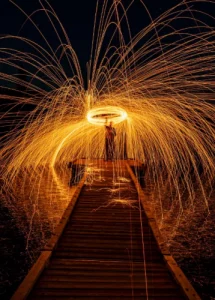
Spinning Fire: A Guide to Steel Wool Photography
I think steel wool photography creates some of the most amazing images you can capture
Share the Love This Valentine’s Day – 25% Off




Pondered why certain cameras capture flawless action, while others result in blurry images? It’s not the lens or body. It’ might be your camera’s sensor.
Digital cameras have change sense they first came out in the early 2000’s Today’s camera sensor’s use advanced electronics to turn light into photos.
The latest tech is stacked sensors. Stacking the processor enhance the surface area for better performance. Meaning the processor and memory are aligned with each other in designs, and not separate.
A small change, but it a big difference. Data moves shorter distances thus transfer is faster.
Whether you’re taking pictures of wildlife or your kid’s hockey game, knowing about this tech helps. It’s not just about speed. It also improves low-light shots and battery life.
Stacked sensors are at the forefront of camera tech. They mix photodiodes, memory, and processing in layers. A big step up from older digital camera.
Unlike they old sensors, stacked sensors have everything needed to process images in one spot. Processing is faster with less noise, picture quality is improved, even in tough lighting conditions.
Stacked CMOS sensors work in layers. The top layer captures light and turns it into electrical signals.
Below the light-capturing layer, there’s memory and processing. When light hits, the signals go straight down to the processing layer. Compared to older sensors, the vertical path here is significantly shorter.
Built-in DRAM acts as a fast buffer, buffering the data before it goes to the main processor, reducing the delays.
This design is highly efficient. The system captures light, processes signals, and stores them in memory before sending them to the main processor. It accelerates the process of extracting data from back-side illuminated sensors and enhances overall performance.
Stacked camera sensors have unique features that make them better than old designs.
One such feature is the memory buffer. It lets the sensor store more data. The camera can now process information more quickly than before.
Stack Sensors has signal processing units that are unique. Upon receiving raw data, they initiate a process that streamlines the main CPU’s task.
In old sensors, data had to travel the whole circuit board. Stacked sensors cut this distance, making data transfer faster and reducing signal loss.
With stacked sensor technology, the light-capturing layer is solely responsible for the light. You may make it more efficient without using circuitry. These modifications will enhance both light capture and performance.
| Feature | Benefit | Impact | Technical Advance |
|---|---|---|---|
| Integraded DRAM | Ultra-fast data buffering | Higher burst rates, reduced blackout time | 5-10x faster data handling |
| Layered Architecture | Optimized component placement | Better low-light performance | Increased photodiode area |
| Dedicated Processing | Faster signal conversion | Reduced rolling shutter effect | Parallel data processing |
| Vertical Signal Paths | Minimal signal degradation | Cleaner images, less noise | Shorter electrical pathways |
| Separated Photodiodes | Improved light sensitivity | Better dynamic range | Optimized light-gathering design |

Looking to stretch your budget? We’ve got good news! Use the SPECIAL code whosaid15 for an extra 5% off
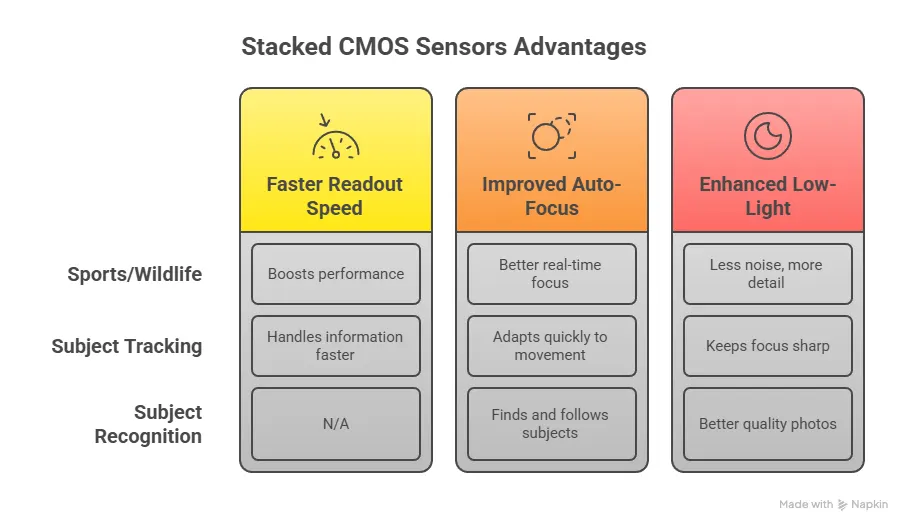
Stacked CMOS sensors bring significant changes to digital photography, solving old problems and incorporating faster readout speed, which boosts performance in many ways.
This new tech is awesome for photographers shooting sports or wildlife. New sensors break through the old limits and handle information faster.
Auto-focus works way better at sending and receiving data. In other words, focusing works better in real time.
Tracking subjects is significantly improved, and most stacked sensor cameras have a greater number of focusing points. Furthermore, they adapt quickly to the movements of subjects.
Recognizing subjects just got better. Cameras can now find and follow faces, animals, or speeding cars with accuracy.
In low light, the faster readout speed reduces thermal noise. This leads to images that are more detailed and have less noise in the shadows.
Auto-focus works better in low light as well. Traditional sensors struggle here, but stacked CMOS sensors keep focus sharp.
For night shots, indoor sports, or events, these benefits mean better quality photos with less noise and more detail. This opens up new creative possibilities in challenging light situations.
Stacked sensor technology has changed digital photography. It brings speed, precision, and performance together.
When Sony released the a9 in 2019, it was a big change. It could shoot 20 frames per second without stopping. Now, cameras like the Sony a1 and Canon EOS R3 can shoot even faster.
To me, dynamic range is the most important part of a sensor for great photos, and stacked sensors handle it differently.
For one, they let more light in, which helps in tough lighting. Designed to catch more detail in shadows and highlights, which is perfect for landscapes and waterfalls where there is a lot of contrast.
Today’s stacked sensors can handle 14-15, whereas the older CMOS sensors were limited to 10-12 stops of dynamic range. So what? You can get more detail in shadows without too much noise.
Mirrorless cameras have gotten better with stacked sensors. Previously, they trailed behind a high-end DSLR. Now, they’re caught up.
One big plus is the silent shutter. You can shoot without interrupting your view. It is ideal for photographers who need to be quiet, like at weddings or with wildlife.
Batteries last longer; you can shoot without changing them as often.
Less distortion, higher frame rates, and improved cooling are available for video.
As stacked sensor tech gets better and cheaper, we’ll see even further adjustments in photography. It has already changed the way professionals work and is making photography more enjoyable for everyone.
Understanding stacked CMOS sensors helps you pick the right camera. Tech has grown, leading to various designs for different needs. From DSLRs to smartphones, each type has its own benefits.
BSI (backside illuminated) and traditional CMOS (complementary metal-oxide-semiconductor) sensors are both used in digital cameras and smartphones to capture images. They turn light into digital image signals. But there are some key differences:
In short, BSI sensors are better at capturing light and often create sharper digital images, especially in dark scenes.
Stacked sensors come in many forms, each with its own benefits. Basic designs have a BSI layer and a circuit layer for faster processing.
Advanced designs Add memory layers for better handling of image data. is great for fast shooting or video.
Some sensors focus on speed, perfect for action shots. Others aim for better dynamic range and colour, ideal for landscapes or portraits.
Adding analogue-to-digital converters to the design also boosts performance. Faster and cleaner data reading from CMOS image sensors
means better images and speed.
| Stacked Sensor Design | Advantages | Best Use Case | Implementation |
|---|---|---|---|
| Basic 2-layer | Cost-effective, improved readout | Entry-level mirrorless cameras | APS-C consumer cameras |
| Memory-Integrated | High-speed burst shooting | Sports and wildlife photography | Professional full-frame cameras |
| High-Density ADC | Superior dynamic range | Landscape and studio work | High-resolution professional cameras |
| Ultra-Compact camera | Space efficiency, power saving | Smartphone photography | Premium smartphones |
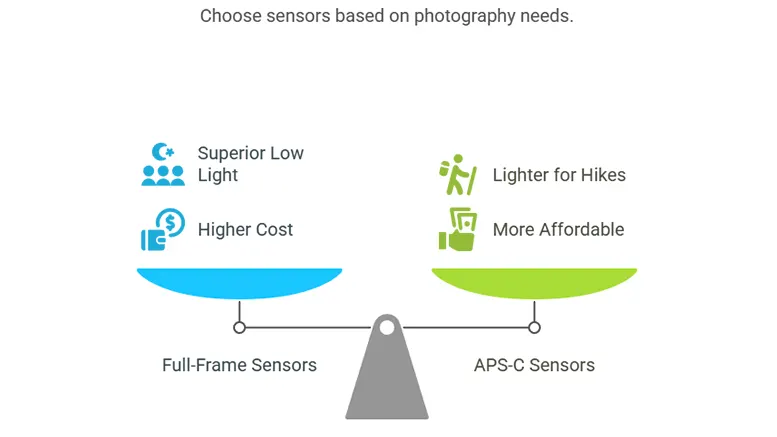
Full-frame sensors are larger, capturing more light. This means better low-light shots and wider dynamic range.
APS-C sensors are smaller but still pack a punch. They offer a good balance between size and performance, and cost.
Choosing between full-frame and APS-C depends on your needs, budget, Both formats offer top-notch performance thanks to stacked sensor tech.
Choosing a camera with stacked sensors means looking at several key points. You want to make sure it fits your photography needs. These cameras are pricey, so think about which of their features match your style.
Don’t just trust what the camera’s makers say about image quality. Test it at different ISO settings that you use. See how well it handles noise and keeps details in both shadows and highlights.
Review the camera’s readout speed for its impact on your photos. If you’re into action shots, check the buffer depth and how long it can shoot continuously. Also, see if it has fast electronic shutter speeds for quick subjects.
The camera’s processing power, thanks to stacked sensors and advanced CMOS image sensors, might offer cool features like advanced autofocus. This can really improve your success rate.
Think about how the sensor size affects your photos. Full-frame sensors are great in low light but cost more. APS-C sensors offer good performance and are lighter on those long hikes.
Even smartphones are using stacked pixel tech, but with smaller sensors. Your choice should balance image quality, size, and your budget.
Stacked sensor technology is a major step forward for digital photography. By layering light-sensitive components, memory, and processors, they allow faster data handling, better image quality, and improved performance in low light. This design also boosts autofocus speed, reduces image noise, and increases dynamic range.
Whether you’re a pro using a full-frame mirrorless camera or a casual smartphone user, stacked CMOS sensors deliver faster, clearer digital images with the help of advanced semiconductor engineering. As this tech becomes more common, it continues to reshape how we capture and experience photography.

Yes, a stacked sensor is good because it offers faster data processing, improved low-light performance, and better autofocus. Stacked sensors enhance image quality by layering light-sensitive components, memory, and processors, making them ideal for action, wildlife, and professional digital photography.
Yes, stacked sensors are better in low light. The stacked design allows faster data processing and improved light capture, reducing noise and enhancing image quality in dim conditions. So, if you’re wondering, “Are stacked sensors better in low light?” the answer is yes.
I think steel wool photography creates some of the most amazing images you can capture

Long exposure photography is a technique that uses slow shutter speeds to capture silky smooth

The first time I went to the Medicine Bowls in Courtenay, it felt like a