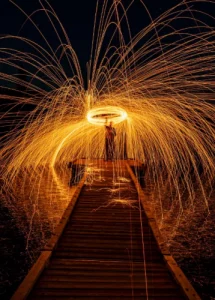
Spinning Fire: A Guide to Steel Wool Photography
I think steel wool photography creates some of the most amazing images you can capture
Share the Love This Valentine’s Day – 25% Off


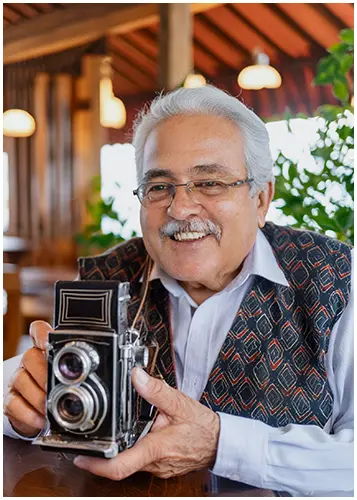

Photography, in its infancy, was less about capturing an instant and more about recording a prolonged moment of reality. The magic began with the camera obscura, which projected an upside-down image of the outside world using a pinhole into a darkened space. Centuries ago, artists used this technique to trace landscapes, showing that even then, people wanted to capture moments in time.
This simple yet profound approach laid the foundation for modern photography and unleashed unprecedented advancements.
Niépce and Daguerre made significant progress in creating photos thanks to chemistry and their creativity. Niépce’s experiment was the kindling that sparked the photographic revolution. He collaborated with Daguerre to create the daguerreotype process, which used a silver-coated copper plate, iodine vapour, and light.
Yet Niépce’s untimely death in 1833 left the torch with Daguerre to refine their vision. By 1837, Daguerre had realized a means to capture sharper images, reducing exposure times significantly from Niépce’s earlier works. Daguerreotypes caused great excitement as photography captured a true and timeless representation of life. The daguerreotype process was groundbreaking but eventually faded, making room for more practical photography methods, showing the constant spirit of innovation.
The advent of roll film was like opening a new chapter in the photographic narrative. Before this innovation, photographers grappled with bulky plates that demanded considerable effort for each shot. Roll film revolutionized this by allowing for multiple exposures on a single long, flexible strip of film. A crucial pivot came when George Eastman, with a flair for simplicity and a shrewd business sense, created the first consumer camera in 1888, “The Kodak,” loaded with a roll film capable of 100 exposures.
Gone are the days when photographers were confined to the darkroom. Now, they have the freedom to take hundreds of pictures in a short period of time. Roll film revolutionized photography, making it more convenient, mobile, and allowing for spontaneous and candid shots. This had a profound impact on the practice of photography as we know it today. Eastman’s genius was not just in the technology, but also in positioning photography within reach of the average person.
Moreover, thanks in part to Oskar Barnack’s pioneering Leica cameras, Eastman’s foundation eventually paved the way for 35mm film to become a standard, encompassing both the realms of motion pictures and still photography. This film size enabled the iconic 24x36mm image format, which remains significant in the digital age, demonstrating the enduring influence of film on the art and science of photography.
Roll film was a catalyst, not just for the technological progress of cameras, but also for the democratization of photography as a cultural and social tool.
The streamlined, manageable dimensions of 35mm film and the innovative design of single-lens reflex (SLR) cameras forever altered photography. The harmonious blend of film affordability and engineering prowess, which allowed precise framing and immediate feedback via the viewfinder, credited this dynamism.
The 35mm film, originally introduced for motion pictures, astonished the world with It’s still photography capabilities around the 1920s and became a consumer favourite due to the perfect balance of image quality and portability. The Leica I, for instance, became synonymous with 35mm photography, making the format immensely popular among amateurs and pros alike. The iconic imagery of street photographers and globe-trotting journalists often carried a 35mm’s camera.
Simultaneously, the world witnessed the rise of SLRs, starting with the compact Ihagee Exakta in the early 1930s and evolving into designs that offered photographers an unobstructed view through the lens. With the creation of the eye-level Pentax and Nikon F, which introduced an entire ecosystem of interchangeable lenses and accessories, the SLR bolstered its position as the camera of choice for photographers who required precision and reliability. The Nikon F, in particular, with its robust build and system support, carved a niche among professional photographers and secured its legacy in photojournalism and various genres of photography.
The convergence of 35mm film and the SLR design redefined photographic practices and equipment standards, setting a precedent that stood the test of time and even transitioned into the digital realm.
Capturing life’s fleeting moments with greater fidelity and ease, this era of camera technology marked a significant leap from the cumbersome apparatus of the past to the user-friendly, cutting-edge devices that challenged even artistically inclined individuals to explore the profound art of photography.

Colour photography, akin to painting with light, initiated an exquisite transformation in the history of visual storytelling. Physicist James Clerk Maxwell, in 1861, made the initial breakthrough in colour photography by taking the world’s first colour photograph of a tartan ribbon. Maxwell’s method was as ingenious as it was rudimentary, requiring three separate black and white photographs through red, yellow, and blue filters, later projected together to manifest the first colour composite image.
Later, at the dawn of the 20th century, Gabriel Lippmann, with a profound understanding of the physics of light, used the phenomenon of interference to produce colour photographs without the need for dyes. Lippmann’s contribution was so profound that it won them the Nobel Prize in Physics in 1908.
The Lumière brothers marketed the Autochrome plate in 1907, bringing colour photography closer to the mainstream. Using dyed grains of potato starch, Autochromes opened up a world where vivid scenes could be rendered in a palette that resonated with reality.
These remarkable forays into colour representation laid the groundwork for future developments and inspired generations to pursue the persistent dream of perfect colour reproduction in photography.
These experimental lenses repainted the narrative of photography, inviting photographers to explore the emotional depth and authenticity that only colour could convey.
The commercialization of colour films greatly contributed to the rise of colour photography from academic circles to consumer hands. Kodachrome, arriving in 1935, emerged as a household name, forever altering the canvas of personal and professional photography. Built on a tri-layered emulsion process, each layer sensitive to a different colour, Kodachrome presented the world in rich, vibrant hues that were previously elusive.
For those who wielded their cameras, Kodachrome was nothing short of a revelation, allowing for the preservation of memories not just in shades but in living colours. It provided photographers with a medium that more closely reflected the subtleties and vivacity of the world as seen by the human eye.
While Kodachrome’s complexity and the cost of processing might have hampered its widespread adoption initially, the surge in interest and technological progress eventually levelled the playing field. By the mid-1960s, colour film had become accessible enough to supplant black and white as the standard for everyday photography. Brands like Fujifilm and Agfa joined the fray, contributing to a colourful mosaic of options that included differing grain, contrast, and saturation characteristics.
Colour film commercialization didn’t just chronicle the world in multicolour; it evolved storytelling, advertising, journalism, and personal mementos. It painted emotions, atmospheres, and contexts with a spectrum that demanded attention and etched images into the public consciousness with greater impact.
Despite the rise of digital, there’s a retained affection for the colour film among analogue enthusiasts who argue for its unmatched aesthetic and nostalgic value, a testament to the profound transformation brought about by the commercialization of colour films.
The Polaroid camera introduced a wave of instant gratification in photography that was unprecedented. This phenomenon struck a chord in the latter half of the 20th century, when Edwin Land introduced a camera that could produce a photograph within minutes of its capture. The Polaroid gripped the imagination of photographers and hobbyists, as the allure of immediate results eliminated the anticipation and delay synonymous with traditional film processing.
Watching a Polaroid develop is a unique experience, with the image magically appearing on the paper before your eyes. This became more than just a process; it was an event, a centrepiece of social gatherings, where friends and family could huddle to see a snapshot of their shared moments come to life.
The Polaroid camera was also a formidable tool for experimentation and creativity. Artists and photographers can now instantly review their work and make artistic decisions on the fly, without the constraint of waiting for film development. This paved the way for more dynamic artwork, where immediacy was key.
From Polaroid’s early models to the sleek SX-70, this form of photography began to symbolize the fast-paced, immediate satisfaction of modern culture. It was more than just a technical triumph; it was a lifestyle, an iconic part of the social fabric representing the here and now.
As digital technology has taken over, Polaroid has maintained a nostalgic charm, with many still cherishing the tangibility and distinct aesthetic of instant film. This emotional connection highlights the lasting legacy of Polaroid as a harbinger of instant gratification in photography.
The evolution of Polaroid cameras is a captivating tale of innovation and design. It commenced with the Polaroid Model 95, the first commercially available instant camera, which hit the market in 1948. This camera, though bulky, was a marvel that enchanted the public, offering the novelty of instant photographs. Over the decades, Polaroid continued to innovate, reimagining not just the photographic process but also the camera designs.
The Polaroid Swinger emerged in the 1960s, targeting a younger demographic with its more affordable price. It was pocket-friendly, both in size and price, featuring an iconic commercial jingle that sang of its ease and accessibility: “Meet the Swinger, the Polaroid Swinger.”
However, the true pinnacle of Polaroid’s innovation came in 1972 with the introduction of the SX-70, a camera that folded down to the size of a thick book when not in use. It featured an SLR design with a reflex mirror and manual focus, a sharp departure from its predecessors’ viewfinder and automatic models. With its ability to lie flat in a briefcase and expand into a camera at the touch of a button, the SX-70 delivered unparalleled convenience and aesthetic ingenuity.
From the imposing Model 95 to the refined SX-70, Polaroid’s range showed a clear trajectory towards increased ease of use and aesthetic appeal. These design innovations allowed Polaroid to adapt to changing consumer preferences while capturing hearts and creating an indelible cultural legacy. The cameras not only served the purpose of capturing memories but also became a stylish icon, desirable for their design as much as for their technological prowess.
Despite fierce competition from digital today, the retro-charm of Polaroid cameras, especially models like the SX-70, inspires a wave of nostalgia and an authentic photographic process that enthusiasts of all ages admire.
Looking to stretch your budget? We’ve got good news! Save an additional 10% use code bwild10
The digital camera heralded a new epoch in the history of photography, transitioning from the physical to the digital, replacing grains of silver halide with pixels poised to capture and store images. This seismic shift began as a nascent concept when Steven Sasson at Eastman Kodak created the first self-contained digital camera in 1975. While primitive by today’s standards, it was groundbreaking, storing images on cassette tape and boasting a resolution equivalent to just 0.01 megapixels.
As the components necessary for digital photography—like CCD and later CMOS sensors—became smaller and more cost-effective, the 1990s saw a burgeoning market for digital cameras. Photographers witnessed a paradigm shift: the camera had become an evolving digital device, no longer restrained by film’s finite frames but emboldened by the seemingly endless capacity of digital storage.
These early digital cameras, while offering advantages in immediate image review and the elimination of film costs, often struggled with image quality and storage capacity. Despite their limitations, the convenience was undeniable; you could now experiment, take multiple shots, and select your favourite without economic repercussions.
One particularly notable milestone was the launch of the Apple QuickTake 100, one of the first digital cameras aimed at the consumer market. The concept of directly transferring images to a computer for viewing and editing was revolutionary, propelling photography into the digital age and aligning it with the burgeoning world of personal computing.
As pixels grew more numerous and image processors more powerful, digital cameras began to surpass their film counterparts in quality and versatility, eventually relegating film to a niche market. This transition to digital not only transformed the tools of the craft, but also expanded the imaginative boundaries possible for photographers.
The transformation was so profound that the line between taking a picture and creating an image became blurred. Photographers could now manipulate images long after the shutter closed, giving rise to new genres and styles that continue to push the boundaries of imagination and creativity.
The digital camera’s advent disrupted and reshaped the photography, democratizing the art form and ushering in an era where the act of capturing an image became instant, repeatable, and accessible to all. As digital cameras continue to thrive, they sustain the promise of peak innovation, fuelling the enduring quest for the perfect picture.
The transition from bulky DSLRs to ever-present smartphones has indeed democratized the realm of photography. No longer are high-quality photos the preserve of those with the financial means and technical know-how to operate advanced cameras. Today, exceptional imagery is achievable with a device that slips into your pocket—the smartphone.
Initially, the images produced by camera phones paled compared to DSLRs. However, as smartphone technology advanced through relentless innovation, the gap narrowed significantly. Modern smartphones not only come equipped with advanced camera sensors but also with software that enhances images through sophisticated processing techniques like HDR and AI-assisted photography.
The accessibility and convenience of smartphone cameras have fostered a culture where everyone is a photographer, capturing and sharing their moments with ease. Professional-grade features like manual control, RAW shooting formats, and high dynamic range, once the domain of DSLRs, are now common on smartphone cameras. However, the game changer lies in instant sharing. The ability to take a picture and instantly broadcast it globally has revolutionized how we communicate, share experiences, and even catalyze social movements.
DSLRs and mirrorless cameras, though, continue to hold their ground, especially among professionals and enthusiasts seeking the utmost control and the highest image quality. Cameras offer larger sensors, more detailed images, and a depth of field that is hard to replicate on a smartphone. Moreover, the tactile experience and the wide array of interchangeable lenses available give them flexibility that a smartphone has yet to match.
The coexistence of smartphones and DSLR cameras is a remarkable narrative of adaptation and convergence. While DSLRs and mirrorless cameras offer unbridled performance for tasks demanding precision, smartphones have profoundly expanded who gets to participate in the art of photography. What we witness today is an eclectic confluence of these two worlds, together propelling the timeless human desire to create and capture beauty.
In this environment, the definition of what constitutes a’real’ photography experience is fluid. The beauty lies in the diversity of choices available, allowing you to select the tool that best resonates with your needs and creative aspirations. As smartphones continue to evolve and DSLRs persist in their legacy of excellence, the clear winner is the enthusiast, who can now capture the world from a myriad of perspectives and devices.

Smartphone cameras have effectively put the power of photography mastery at your fingertips. With high-resolution sensors, multiple lens setups, and advanced computational photography, these pocket-sized powerhouses enable you to capture stunning images without lugging around heavy gear.
Not only do smartphone cameras offer the convenience of portability, but they also boast an impressive set of features that were once exclusive to high-end cameras. Advanced autofocus, image stabilization, and low-light capabilities allow for professional-looking results in a variety of conditions. Plus, the ability to shoot 4K video and slow-motion footage adds to the creative toolkit available to anyone with a smartphone.
The main benefits of smartphone photography boil down to immediacy and connectivity. You can edit your creations on the same device and share them with the world in moments, a workflow that seamlessly fits into the fast-paced, interconnected lifestyle of most people today.
Top five features:
Five Benefits:
Two Cons:
Smartphone cameras are best for individuals who desire convenience, spontaneity, and social connectivity. Whether you’re an avid traveller, social media influencer, or just someone who enjoys capturing the daily beauty around them, smartphone cameras provide a powerful and user-friendly gateway into photography.
Keeping pace with technology in photography means continually embracing new tools and trends that shape how professionals capture and process images. As a professional photographer, you’re likely aware of the considerable pressure to stay current with the latest technological advancements, ensuring that the quality and creativity of your work remain top-notch.
Today, professional tools encompass high-resolution DSLRs and mirrorless cameras boasting incredible dynamic range, 4K and even 8K video capabilities, and lightning-fast autofocus systems with eye and face detection. These features have elevated what’s possible in image-making, allowing for stunning detail and clarity that surpass what was achievable just a few years ago.
Furthermore, tools extend beyond the cameras themselves. Professional software for image editing and management, like Adobe Photoshop and Lightroom, has progressed by leaps and bounds, offering photographers powerful yet intuitive ways to enhance their pictures. Features such as sky-replacement and content-aware fill in Photoshop, as well as the advanced colour grading tools in Lightroom, can transform a good photo into a masterpiece.
Trends in Photography:
Staying abreast of these trends means that professionals are better equipped to deliver the creativity and impact demanded by clients and audiences. Staying updated with technology involves more than just acquiring the latest devices; it involves utilizing these tools to craft a unique photographic style that aligns with the current era.
Professional photography tools are for those who demand the utmost control and quality from their craft. They are for artists who view technology not as a crutch but as a canvas—a way to push boundaries and redefine the limits of what’s possible in the visual narrative. For students, enthusiasts, and industry veterans alike, understanding and harnessing contemporary tools and trends is an exciting part of the photographic journey.
Integrating AI and computational photography marks a visionary leap in how camera technology captures and processes images. AI often assists in scene detection, automatically adjusting settings like exposure, focus, and colour balance to enhance the end result. Some smartphone cameras now feature modes that can capture the perfect shot even before you’ve thought to press the trigger, thanks to predictive algorithms trained to recognize the signs of an impactful photo.
Computational photography takes things a step further by combining multiple exposures to create a single image with a dynamic range that would be impossible with traditional methods. Features such as Night Mode, Portrait Mode with simulated bokeh, and HDR photography are testament to this. AI-powered tools can also correct images blurred by motion or out-of-focus shots, refine details lost in the shadows or overexposed highlights, and tackle intricate tasks such as upscaling resolution while maintaining image clarity.
AI’s Role in Camera Technology:
This integration is transforming not only the operation of cameras but also the expectations of professional photographers. With AI doing some of the heavy lifting, photographers can concentrate on composition and storytelling while the camera takes over technical adjustments.
AI and computational photography present a thrilling new chapter for camera evolution, holding the promise of infinite creative possibilities. This technology is particularly beneficial to those who relish cutting-edge tools that augment their photographic skills, making it easier to create standout images in an increasingly visual world.
The trajectory of camera technology hints at a future brimming with possibilities that could further revolutionize how we capture and experience images. Anticipating what comes next entails looking at emerging trends and research that are likely to shape camera technology in the coming years.
We can expect to see further refinement in the integration of AI, with cameras becoming even smarter and more intuitive, with capabilities ranging from enhanced predictive behaviours to AI-based noise reduction for crystal-clear images in low-light conditions. The AI has now extended into post-processing, offering photographers finished images that require minimal manual editing.
Another anticipated development is the improvement of quantum film sensors, which promise to surpass the limitations of current sensor technology with higher sensitivity and reduced noise, potentially changing the essence of photography in challenging lighting conditions. Improvements in 3D and holographic imaging could lead to cameras that capture the depth and spatial dimensions of a scene far more realistically.
Advances in augmented reality (AR) may bridge the gap between photography and immersive experiences, allowing for interactive photographs that offer a multisensory experience extending beyond visual input. AR could potentially allow photographers to preview and modify lighting or backgrounds in a scene in real-time before taking the shot.
Consider the possibilities of foldable and flexible display technology that could redefine the physical form of cameras, making them more adaptable and durable, as well as continued miniaturization that would transform the portability of powerful imaging devices. Alongside technical advancements, we may witness a sustainably conscious manufacturing shift where camera technology aligns with eco-friendly and ethical practices.
These advancements point towards an exciting future where cameras serve not only as tools for recording but as extensions of human perception, pushing the boundaries of how we visualize and interact with the world around us. As technological advancements unfold, they promise to empower photographers with even greater capabilities and inspire new forms of visual art.

Joseph Nicéphore Niépce used a camera to take the first photograph in 1826, although the camera’s origins date back to the ancient concept of the camera obscura. The device evolved from the camera obscura over centuries, with the first portable box camera introduced in the early 19th century.
Joseph Nicéphore Niépce took the first-ever photograph in 1826. Niépce captured this image, known as “View from the Window at Le Gras,” from the window of his estate in France.
Polaroid cameras introduced instant photography, leading to immediate image gratification and changing the way people interacted with photos. They paved the way for a more spontaneous and informal approach to photography, offering the joy of instantly sharing pictures in social settings.
Smartphone photography has transformed cameras by embedding advanced technology within everyday devices, making photography highly accessible and social. This evolution has shifted the focus to software-driven features, promoting sharing and instant image manipulation.
I think steel wool photography creates some of the most amazing images you can capture

Long exposure photography is a technique that uses slow shutter speeds to capture silky smooth

The first time I went to the Medicine Bowls in Courtenay, it felt like a